ServicesStair Flooring
Stair Flooring in La Porte
We cover staircases in hardwood, luxury vinyl plank, laminate or carpet, and we explain how each option handles the nosing, the riser and daily foot traffic. Every step is measured on its own, re-fastened where it moves, and finished to meet the floor above and below it.
A Staircase Is the Hardest Part of a Floor
A flat room forgives a lot. A stair does not. Each tread takes your full weight at the front edge, the nosing gets kicked on the way up, and no two steps in a typical house are cut exactly alike. A plank that wears well across a living room can split, lift or wear through on a stair if the wrong trim or fastening is used.
Many two-story homes around the Houston area were built with carpet over particleboard or OSB treads. That base was never meant to be seen, so moving to a hard surface means either capping it or replacing it with real treads. We look at what is under your carpet before recommending a surface, and we tell you which options suit your stair and which ones will cause trouble.
We have been in business 25+ years, and stairs are often the part of a flooring job that shows the difference between a careful installer and a fast one.
What Stair Flooring Work Includes
- 01
Removal down to the structure
We pull old carpet, pad, tack strip and staples, or lift worn vinyl and laminate. That exposes the treads and stringers so we can see what we are building on.
- 02
Squeak and movement repair
Squeaks usually come from a tread rubbing on a nail or the stringer. We re-fasten loose treads with construction adhesive and screws before any new covering goes down, because a new surface will not quiet a moving step.
- 03
Nosing made for each floor type
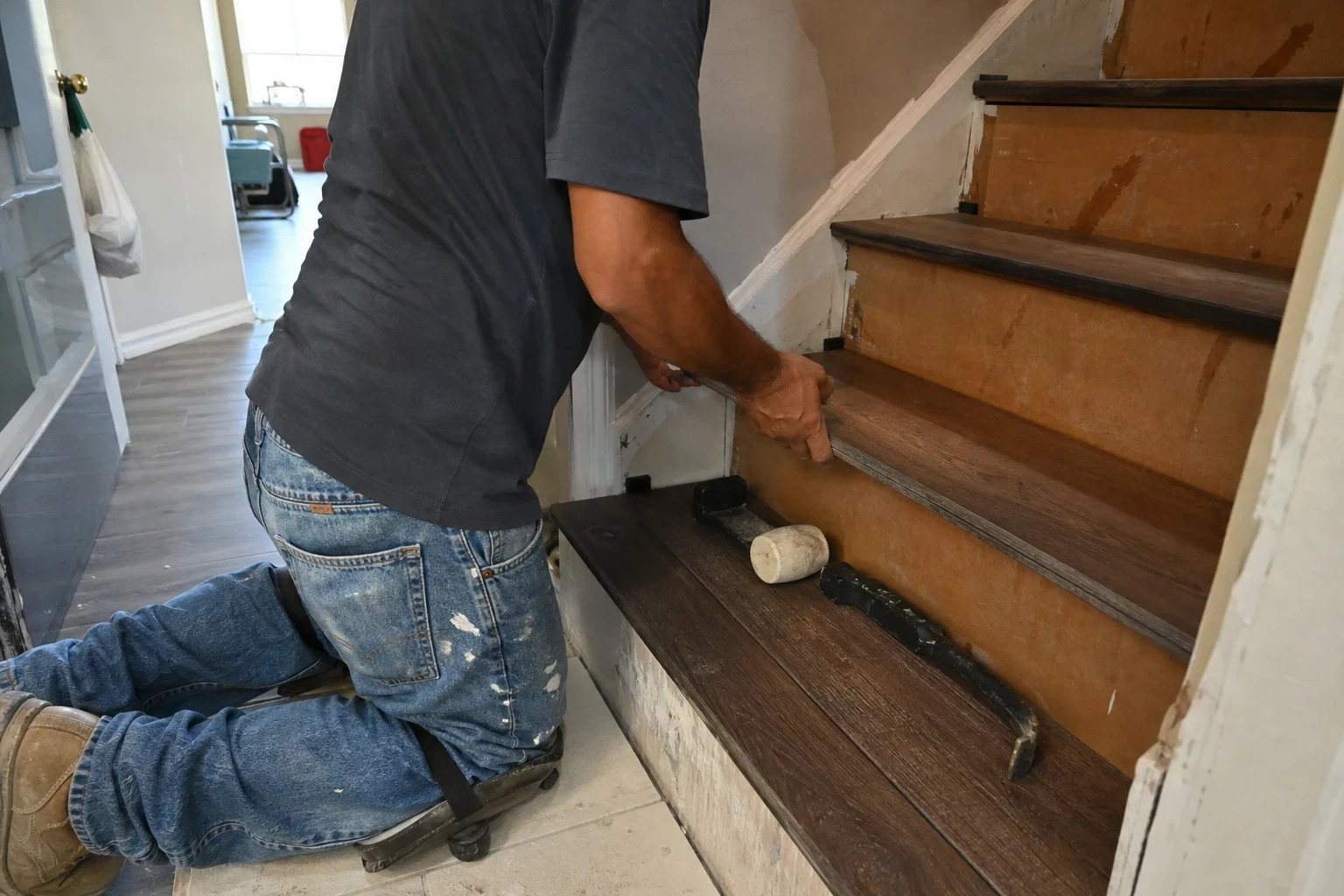
Vinyl plank and laminate need a matching stair nose, either flush-mount or overlap, glued and fastened so it cannot rock. Hardwood gets solid treads with a milled bullnose. Carpet is wrapped waterfall style or tucked under the nose in a cap-and-band finish.
- 04
Risers and skirt edges
Risers can be covered to match, done in a contrasting color, or left for paint. Where the stair meets a wall or open side, we scribe pieces to the skirt board and miter returns so end grain and cut edges are hidden.
- 05
Top and bottom transitions
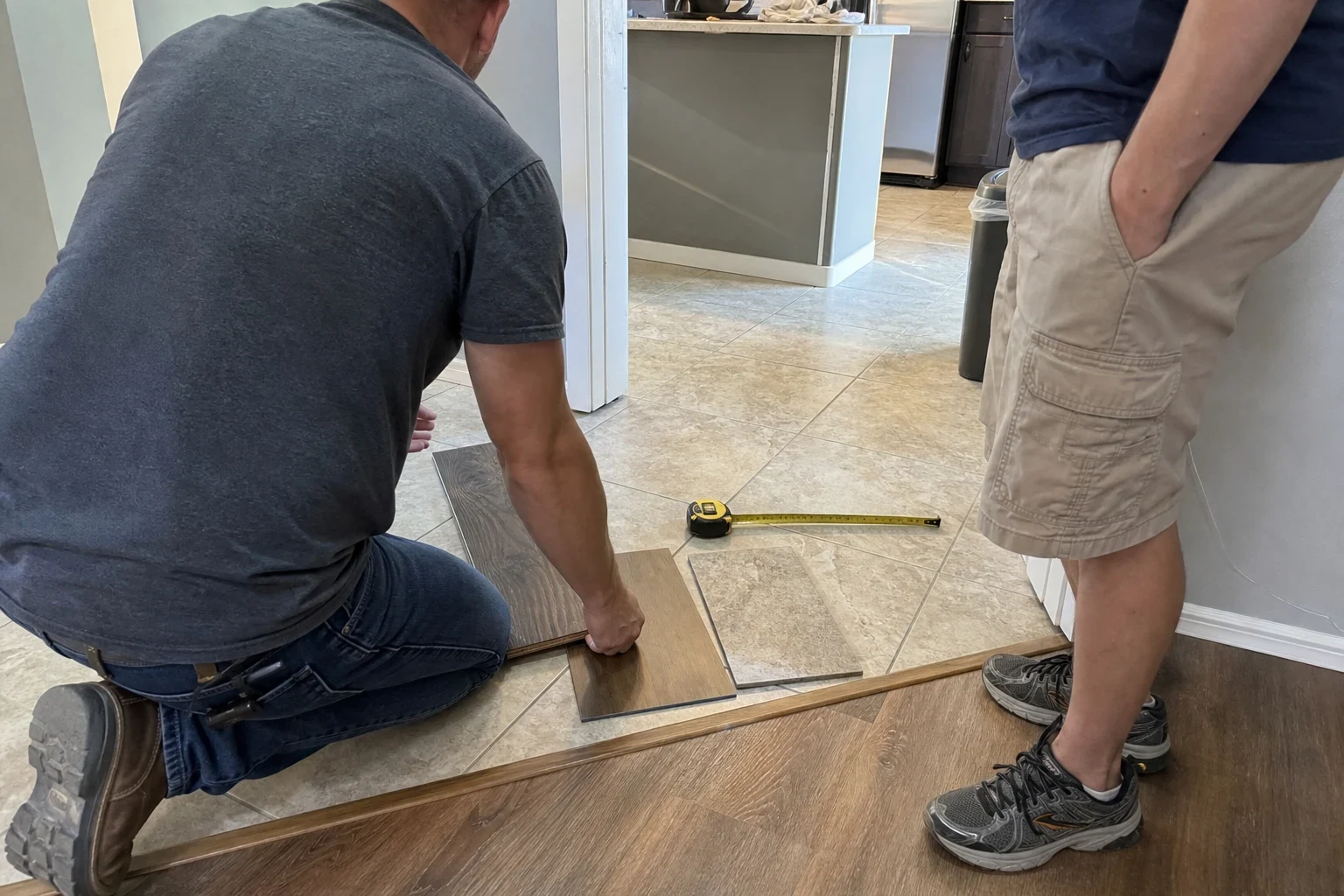
Residential code limits how much one riser height may differ from the next. Adding flooring thickness at the landing or the bottom step changes those heights, so we plan the transitions to keep the steps even.
Questions about Stair Flooring?
Call(346) 248-3976Signs Your Stairs Need New Flooring
Carpet worn through at the nose
The front edge of each step wears first. Once you can see backing or pad at the nosing, the carpet is past saving there even if the rest looks fine.
A nosing that rocks or lifts
A loose vinyl or laminate nose is a tripping hazard. It usually means the trim was set with too little adhesive or over an uneven tread edge.
Steps that squeak or flex
Movement underfoot points to loose fasteners or a gap between tread and stringer. It is best fixed while the covering is off.
New floors that stop at the stairs
If you have put luxury vinyl plank, laminate or hardwood flooring downstairs, a carpeted stair can look like an unfinished job. Matching or coordinating the stair ties the two levels together.
Slick or peeling edges
Worn finish on hard treads, or a curling edge on laminate, makes stairs slippery and lets moisture into the core.
How a Stair Job Runs
- 1
Measure every step
We measure each tread and riser on its own, plus landings and any open sides. Stairs are often slightly out of square, and one template does not fit them all.
- 2
Talk through materials
We lay out how hardwood, vinyl plank, laminate and carpet each behave on your stair, including how the nosing is made and how each one wears at the edge. You choose with the trade-offs in front of you.
- 3
Tear-out and prep
On install day we remove the old covering, pull fasteners, re-secure loose treads and sand down high spots. We protect the floor at the base of the stairs while we work.
- 4
Install from the bottom up
Treads, risers and nosings are cut and fitted one step at a time. Glued components need time to set, so we tell you ahead of time how long the stair should stay out of use, and we leave a route if one is possible.
- 5
Walk-through and cleanup
We check every nose for movement, clean up dust and offcuts, and go over care for the floor you chose. All installations carry our 1-year workmanship warranty.
What Moves the Price of Stair Flooring
Stairs are priced by the step, not by the square foot, because the labor is in the cutting and fitting. The material you pick matters, but so does what we find once the old covering is off. We explain each line on the phone and again after we measure.
- Number of steps and landings
- A straight run of thirteen steps is simpler than a stair with a landing, a turn or winder steps, which need angled cuts.
- Open or closed sides
- An open stair needs mitered returns on each tread. If balusters sit in the treads, they have to be removed and reset.
- Material and nosing type
- Solid hardwood treads cost more to buy and fit than vinyl plank with a matching nose. Carpet is generally the least labor per step.
- Condition underneath
- Damaged particleboard treads, loose stringers or old glue may need replacement or extra prep before the new surface goes on.
Stair Flooring Questions
Can luxury vinyl plank go on stairs?
Yes, with a matching stair nose made for that product. The plank covers the tread, the nose wraps the front edge, and both are glued down rather than floated. A floating install on a stair would shift with every step.
Do I have to replace my treads to get hardwood?
Not always. Thin cap treads can go over existing treads in some cases, while full replacement gives a solid tread with a true bullnose. Which one fits depends on your current treads and on keeping riser heights even, and we check both before recommending one.
How long will the stairs be out of use?
Carpet is usually walkable as soon as it is installed. Glued hard surfaces need set time before full traffic, which we will tell you for your specific product. If your stair is the only way upstairs, we plan the work around that.
Can you match the flooring we already have downstairs?
Often, if the manufacturer still makes the product and a matching nosing. If it is discontinued, we can suggest a coordinating color or a contrasting tread that looks intentional.
Is the stair work covered after you leave?
Yes. We are insured, and we give a 1-year workmanship warranty on all installations, stairs included. If a nose loosens or a seam opens because of our workmanship in that time, that is what the warranty is for.
Talk Over Your Staircase
Tell us what is on your stairs now and what is on the floors around them. We will walk through which materials make sense and what the job involves before anyone pulls up a tack strip.